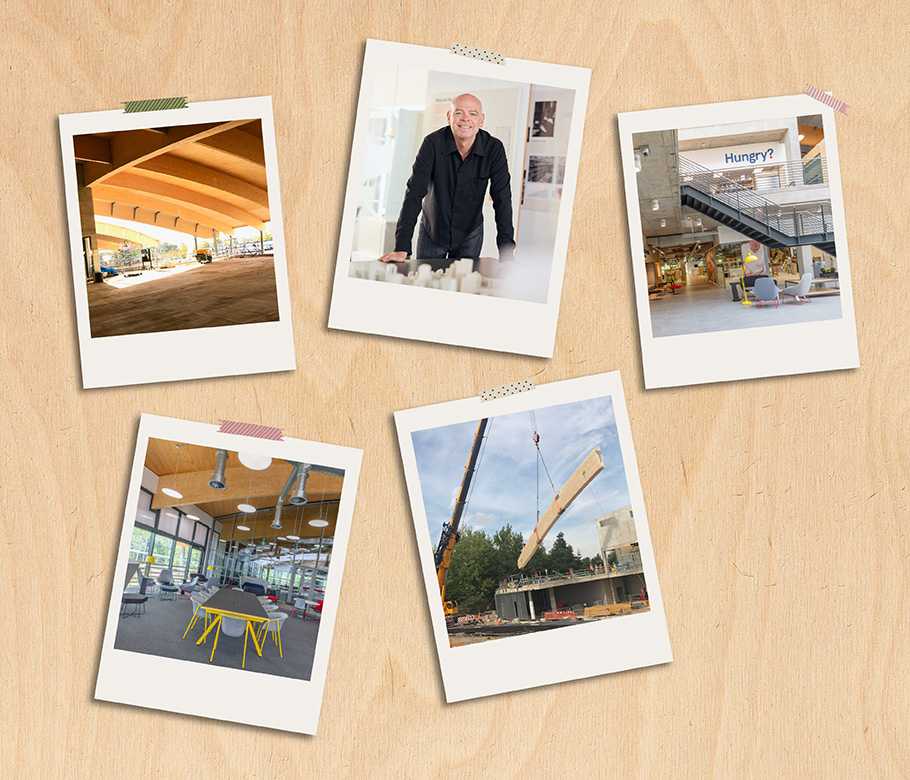
Our Associate Director Patrick Hastings has helped to shape some of LOM’s most technically ambitious projects. We sat down with Pat to discuss materiality and problem-solving, from lessons learned on early residential projects to the value of time spent on site, and how the success of great architecture lies in the details.
What lessons did you take from working on smaller projects early in your career?
Early in my career I worked predominantly on small residential projects, and that experience was invaluable. Smaller scale buildings, particularly houses, forced me to address the fundamentals of construction in a very direct way. I was dealing with the basics, primarily keeping the rain out and heat in. Those principles don’t change on larger projects; they are simply scale up. Understanding building fabric, detailing, and how different elements come together at a small scale gives you a grounding that’s incredibly transferable.
“I think that an early exposure to whole-building thinking is a really valuable foundation.”
How does time spent on site influence your design and decision‑making?
Spending significant time on site has definitely influenced the way I detail and communicate design intent. When you’ve witnessed contractors’ express frustration over impractical detailing, you begin to put yourself in their mindset. You start asking yourself: is this being communicated clearly? Is it legible? Is it genuinely buildable? It can be easy to draw something in 2D and not fully consider the practicalities for the person faced with constructing it. Spending full days onsite has given me a much broader appreciation of the realities of delivery. Whilst I wouldn’t necessarily say it made me a “better” designer in a conceptual sense, it has given me a better understanding of how construction information is best communicated as being onsite gives you insights into the pressures contractors operate under.
Where do you see the merit of using concrete as a primary material?
For me, the beauty of concrete lies in its raw honesty and durability. There’s nowhere to hide with exposed concrete as it demands great precision and there is very little scope for rectifying mistakes so the detailing must be right. Part of the appeal lies in that moment of anticipation, when the shuttering is removed revealing the concrete bringing a mix of nerves and excitement.
The Heart Building for Tesco used exposed concrete with a variety of finishes. What are the key considerations in achieving high‑quality concrete work?
My first major project involving extensive exposed concrete was the Heart Building for Tesco, at their head office in Welwyn Garden City, I learned that achieving high-quality results depends upon an understanding of detailing, fixing methods and the limitations of formwork. Different types of shuttering can create very different finishes, from expressed timber grain to super-smooth fine surfaces and those choices must be considered early in the design process as they impact cost and program.
For the Heart Building the design team championed the use of structural timber and glue‑laminated beams. What drove that material choice?
The use of glue-laminated timber beams was driven by both aesthetic and environmental considerations. Visually, the warmth and richness of the timber created an interesting contrast with the more austere concrete elements. That juxtaposition was important to the character of the building. It was also a more sustainable structural choice. The timber structure allowed us to introduce a sustainable resource into the building. Technically, glue-laminated timber beams enabled long spans, in this case beams of up to 30 metres and provided a robust and elegant structural solution.
You have mentioned Tadao Ando’s attention to detail. What do you find inspiring about his work and how has it influenced your approach?
Tadao Ando has long been a key reference for me, particularly during my time at university. His work embodies simplicity, but when studied closer, the detailing is incredibly sophisticated. There’s a very strong sense of geometry and restraint, but also a deep sensitivity to texture, especially in his use of concrete. The finish, the alignment of joints, the precision of openings, everything is carefully considered. What’s inspiring is the ability to make something highly complex in execution appears effortless and simple.
“His work embodies simplicity, but when studied closer, the detailing is incredibly sophisticated.”
What aspects of Gunnar Asplund’s architecture resonate with you?
Gunnar Asplund resonates with me because of his works simplicity and timelessness. His Stockholm Public Library, completed in the 1920s, is a project I find particularly inspiring. The central cylindrical volume is generous in scale and is completely lined with books around the perimeter. It is a highly restrained building, yet incredibly powerful. There’s a Nordic warmth in the use of materials and books as backdrop that contrasts dramatically with the modern clarity of the internal space. What stands out is its enduring relevance. Unlike many buildings that can be easily dated to a particular decade, Asplund’s work retains a timeless quality.
Tell us about your experience of “problem solving with the details”
One particularly challenging example from the Heart Building project involved long glue laminated timber beams penetrating the façade of a curved building. Because the roof was parabolic and nothing was orthogonal, every junction was geometrically complex. Beams, around 30 meters long, would potentially move due to thermal changes, wind loading, and snow loads. We had to allow for up to 20mm of movement where they passed through the façade. The challenge was designing a detail that accommodated this movement while remaining airtight and watertight. It took weeks of collaborative work to resolve. Those kinds of challenges are demanding but rewarding.
“When the solution finally works and performs as intended, it’s incredibly satisfying.”
How do you balance design intent with the pressure contractors face during delivery?
Ultimately, when a project is being delivered it is often shaped by constraints upon time and money, both of which can be in short supply. A greater budget does not always guarantee a better result, but extreme financial constraints can certainly adversely impact a project. Balancing these factors against design intent means recognising those realities. You may begin with an idealised solution, but delivery always involves some negotiation. The key can be understanding where focus matters to ensure that fundamental aspects of the design remain intact, while remaining pragmatic about programme and cost. It’s a continual balancing act between aspiration and feasibility.